Δευτέρα 1 Σεπτεμβρίου 2008

Etymology of flame

Etymology of flame.

Flame comes from the Latin flamma (flame), which is related to the Greek verb φλέγω (flego; to burn, blaze).

From the same room: flambeau

In modern Greek.
α) φλόγα: flame [floga]
β) φλέγω: burn [flego]

OED

Η λέξη flame προέρχεται από το Λατινικό flamma, το οποίο σχετίζεται με το ρήμα φλέγω.


___________________Post 49. __________________

Etymology of scope

Etymology of scope.
Scope (aim, purpose, an end, extent or range of view) derives from the Latin scopus, from the Greek σκοπός (scopos; scope) from the verb σκοπέω (scopeo; aim, intend, watch).

In modern Greek.
a) σκοπός: aim, goal, end, sentry [scopos]
β) σκοπεύω: aim, intend [scopevo]
γ) σκοπιά: look-out post [scopia]
δ) σκόπιμα: adj intentional [scopima]

OED

Η λέξη scope (σκοπός, εύρος) προέρχεται από το Λατινικό scopus, από το ελληνικό σκοπός από το ρήμα σκοπέω (-ώ).

______________________ Post 48.______________


Etymology of door

Etymology of door.

The word DOOR is related to the Greek word θύρα (thyra; door).
The same word θύρα (thyra; door) and its Aeolic form φύρα (fyra) is related to the Latin foris (door) and fora (out of doors) and through it the English forth.

In modern Greek
a) θύρα: door, gate [thyra]
β) θυρεός: escutcheon [thyreos]
γ) θυροειδής: thyroid [thyroidis]

OED

Η λέξη DOOR (θύρα, πόρτα) σχετίζεται με  την ελληνική λέξη θύρα

___________________________Post 47. ____________________


Etymology of crown, corona

Etymology of crown, etymology of corona

The word CROWN derives from the Latin corona (crown), which is related to the Greek κορώνη (corone; curve, crown, garland)

From the same root: corona, cornice, coronet

In modern Greek:
a) κορώνα: crown [corona]
b) κορωνίς: apex, top, cornice [coronis]

OED

Η λέξη CROWN (στέμμα) προέρχεται από το Λατινικό corona (στεμμα), το οποίο σχετίζεται με τοελληνικό κορώνη. Από την ίδια ρίζα προέρχεται και η λέξη κορνίζα (cornice).


_____________________________Post 46. ______________


Κυριακή 10 Αυγούστου 2008

ETYMOLOGY OF DENSE, DENSITY

Etymology of dense

The adj dense derives from the Latin densus (dense), which is related to the Greek adj δασύς (dasys; dense).

From the same root: density

In modern Greek.
α) δασύς: dense, thick [dasys]
β) δασύτητα: density, denseness [dasytita]

OED

Το επίθετο dense (πυκνός) προέρχεται από το Λατινικό densus (dense), το οποίο σχετίζεταιμε το Ελληνικό δασύς.

_______________________Post 45.________________


Σάββατο 26 Ιουλίου 2008

ETYMOLOGY OF NEW, NOVICE

Etymology of new and novice

The words new and novice derive from the latin novus (new), is related to the greek adj νέος (new; neos). The word neo- (new; neo) is also used as a prefix in many words such as neolithic, neologism, neophyte, neoplasm, neoplatonism etc.

From the same root: news, novelty, novel, novelist, nova, neon

In modern Greek.
α) νέος: new, young, modern [neos]
β) νεότητα: youth, early years [neotita]
γ) νεόφυτος: newly baptized, novice, neophyte [neophytos]
δ) νέα: news [nea]

OED

Οι λέξεις new (νέος) και novice (αρχάριος, νέος) προέρχονται από το Λατινικό novus (νέος), το οποίο σχετίζεται με το ελληνικό νέος.


_____________________ Post 39. ___________________


Etymology of rice

Etymology of rice

Rice derives from the Italian riso, from the Latin oriza, from the Greek oryza (rice).


In modern Greek.
α) ρύζι: rice [rizi]

OED


Η λέξη rice (ρύζι) προέρχεται από το λατινικό oriza, από το ελληνικό όρυζα._

_____________________________Post 36._______________________

Etymology of vomit

Etymology of vomit

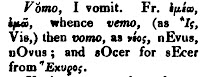
The word vomit came from the Latin vomitare from vomo (I vomit), which is related to the greek verb εμέω - εμώ (emo; I vomit).

In modern Greek
α) εξεμώ or κάνω εμετό: to vomit [exemo or kano emeto]
β) εμετός: vomit [emetos]

OED

Η λέξη vomit (εμετός, κάνω εμετό) προέρχεται από το λατινικό vomo (κάνω εμετώ), το οποίο σχετίζεται με το ρήμα εμέω - εμώ.

___________________________Post 35. ____________________


Σάββατο 28 Ιουνίου 2008

ETYMOLOGY OF SCRIPT, SUBSCRIPTION, INSCRIPTION, DESCRIPTION, SRIPTURE.

Etymology of script, subscription, inscription, description and Scripture.

The noun SCRIPT (something written) comes from the Latin scriptum (a writing, a book, a mark) from the verb scribo (to write), which is related to the Greek verb σκαριφώ (σκραιφώ) (scarifo - screfo; make a scratch, trace or mark with a pencil, write).

From the same root: subscribe, subscriber, subscription, inscription, description, Scripture.

In modern Greek:
α) σκαρίφημα: sketch, rough drawing [scarifima]
β) σκαριφώ: sketch, draw roughly [scarifo]

OED

Το ουσιαστικό SCRIPT (κείμενο, γραφή) προέρχεται από το λατινικό scriptum (κείμενο, βιβλίο) από το ρήμα scribo (γράφω), το οποίο σχετίζεται με το ελληνικό ρήμα σκαριφώ (σκραιφώ).

_______________________Post 34.______________________


Κυριακή 15 Ιουνίου 2008

Etymology of bishop

Etymology of bishop

The word BISHOP derives from the Latin episcopus (bishop; contraction of both the beginning and the end of the word), from the Greek επίσκοπος (episcopos; watcher, overseer), from επί- (epi-; over) + σκοπός (scopos; watcher) from the verb σκοπέω (scopeo; observe, see).


In modern Greek
α) Επίσκοπος: bishop [episcopos]
β) επισκόπηση: inspection, review [episcopisi]
γ) επισκοπή: bishopric [episcopi]
δ) επισκοπώ: review, inspect [episcopo]
ε) σκοπός: aim, goal, object, scope, watcher, guard [scopos]
στ) σκοπιά: observation/look-out post, watch-tower [scopia]

OED
_
Η λέξη BISHOP (επίσκοπος) προέρχεται από το λατινικό αντίστοιχο episcopus, από το ελληνικό  επίσκοπος.


_____________________Post 33. ____________________
_


Etymology of MORON and IDIOT

Etymology of moron and idiot.

The word MORON (foolish, stupid, idiot) derives from the Latin morus, from the Greek μωρός (moros; fοοlish, stupid).


The word IDIOT (stupid, foolish, dull, moron, mentally dificient person) derives from the Latin idiota, from the Greek idiotis (person lacking professional skill, lit. private person used for ignorant person) from idios (one's own).


From the same roots: idiom, idiomorphic, idiopathy, idiosyncrasy etc.

In modern Greek
α) μωρός: stupid, foolish [moros]
β) μωρία: folly, stupidity [moria]
γ) μωρό: baby [moro]
δ) μωρολογία: nonsense, idle talk [morologia]
ε) μωραίνω: stupefy, drive mad [moreno]
στ) ιδίωμα: idiom [idioma]
ζ) ιδιωτεύω: retire into private life [idiotevo]
η) ιδιώτης: private individual, civilian [idiotis]
θ) ιδιωτικός: private, personal [idiotikos]
ι) ιδιόχρηστος: used by the owner himself [idohristos]


OED
OED2
_


Η λέξη MORON (μωρός, ηλίθιος, πνευματικά ελλειπής ) προέρχεται από το λατινικό morus, από το ελληνικό μωρός.

The word IDIOT (μωρός, ηλίθιος, ) προέρχεται από το λατινικό idiota, από το ελληνικό ιδιώτης, από το ίδιος.

_____________________________Post 32. ________________


Σάββατο 14 Ιουνίου 2008

Etymology of butter

Etymology of butter.

The word BUTTER derives from the Latin butyrum (butter), from the Greek βούτυρον (boutyron; cow-cheese, butter) from βους (bous; cow) and τυρός (tyros; cheese).
_
In modern Greek:
α) βούτυρο: butter [butyro or better vutyro]
β) τυρί: cheese [tyri]
γ) βόδι: cow [bodi or better vodi]

OED
_
Η λέξη BUTTER προέρχεται από το λατινικό butyrum (βούτυρο), από το ελληνικό βούτυρον από το βους και τυρός.

_________________ Post 30. __________________

Δευτέρα 26 Μαΐου 2008

ETYMOLOGY OF LIBRARY, LIBRARIAN, LEPROSY, LEPER

Etymology of LIBRARY and LEPROSY.

The word library came into English from the old French librairie (collection of books) noun use of adj. librarius from the Latin librarium (chest for books) from liber (gen. libri; book, paper, originally the inner bark of trees) which is related to the Greek Aeolic form λέπορ (bark of a tree) from the verb λέπω (to peel, to strip off the bark of a tree or plant). Books were anciently made by the inward bark of a plant.

Moreover, the same verb λέπω (lepo; peel) is related to the word λέπρα (lepra; leprosy) and the Latin lepra and this is the root for the words leprosy and leper.

In modern Greek.
α) λέπρα: leprosy [lepra]
β) λεπρός: leper [lepros]

OED
OED2
_
Η λέξη library (βιβλιοθήκη) προήλθε από το γαλλικό librairie (συλλογή βιβλίων) που προήλθε από το λατινικό librarium από το liber (γεν. libri, βιβλίο, αρχικώς ο εσωτερικός φλοιός των δέντρων) το οποίο σχετίζεται με την αιολική μορφή λέπορ από το ρήμα λέπω (απολεπίζω, ξεφλουδίζω). Τα βιβλία στην αρχαιότητα συχνά φτιάχνονταν από φλοιό δέντρων.

Το ρήμα λέπω σχετίζεται καί με την λέξη λεπρός και λέπρα.

_______________________Post 27. ________________


Κυριακή 25 Μαΐου 2008

ETYMOLOGY OF PAIN, PENALTY, PENAL.

Etymology of PAIN and PENALTY

The noun pain (punishment, especially for a crime; condition one feels when hurt, opposite of pleasure) came into English from the old French peine, from the Latin poena, from the Greek ποινή (poene; punishment, penalty).

_
From the same root: penal, penalty, penance, penalize, penalization, penally, painful, painless, pain-killer, painstaking.
_
In modern Greek:
α) πόνος: pain, ache, suffering [ponos]
β) πονοκέφαλος: headache, hang-over [ponokefalos]
γ) πονόλαιμος: sore throat [pono-lemos]
δ) πονόδοντος: toothache [pono-dontos]
ε) ποινή: sentence, penalty, punishment [pini]
στ) ποινικός: adj criminal, penal [pinikos]
ζ) ποινικοποιώ: penalize [pinikopio]
η) πέναλτι: penalti [penalte]
θ) πονώ: vti pain, ache, hurt, be in pain [pono]

OED
_
Το ουσιαστικό pain (πόνος, τιμωρία) προέρχεται από το γαλλικό peine, που με τη σειρά του προέρχεται από το λατινικό poena, από το ελληνικό ποινή. Από την ίδια ρίζα προέρχεται και το πέναλτι (ποινή, κύρωση)

_______________________ Post 26. ______________


ETYMOLOGY OF PUNISH, PUNISHMENT

Etymology of  PUNISNMENT

The verb punish came into English from the old French puniss-, extended prp. stem of punir (to punish) from the Latine punire, from poenire from poena, from the Greek ποινή (poene; punishment, penalty).

From the same root: punishment, punishable, punitive, punitory

In modern Greek: 
ποινή: punishment, sentence, penalty

OED
_
Το ρήμα punish (τιμωρώ) προέρχεται από το λατινικό punish, από το ουσιαστικό poena από το ελληνικό ποινή.
______________Post 25_____________