Εμφάνιση αναρτήσεων με ετικέτα etymology of latin. Εμφάνιση όλων των αναρτήσεων

Κυριακή 13 Μαΐου 2012

Etymology of camera


The word camera (a device that records and stores images; vaulted building), comes from the Latin camera (vaulted room), which is a transliteration of the Greek word camara (a vault, arched roof or ceiling, vaulted chamber; room). The word was also used as a short for camera obscura (dark chamber; a black box with a lens that could project images of external objects), and thus it became the word for "picture-taking device".
.
In modern Greek:
a) camera: camera [Gr: κάμερα; loanword]
b) camara: arch, arcade [Gr: καμάρα]
c) camara: room [Gr: κάμαρα]
d) camariera: chambermaid [Gr: καμαριέρα]
e) camarini: dressing room, green room [Gr: καμαρίνι]

OED

______________________ Post 218. ______________________

Κυριακή 14 Νοεμβρίου 2010

Etymology of caliber

Origin of caliber

Caliber comes from the old French calibre (14c.), from the Arabic qalib "a mold, last", which derives from the Greek calapous [Gr: καλάπους] "a shoemaker's last" lit. "little wooden foot," from calon "wood" + pous "foot"*.


From the same root: calibrate, calibration.


In modern Greek:
a) calapodi: a shoemaker's last, a little wooden foot [Gr: καλαπόδι]
b) calibraro: calibrate [Gr:καλιμπράρω], loanword


* Babiniotis G. Etymological Lexicon of Modern Greek Language p614 and p615
.
_______________________________________ Post 154. __________________
.


Σάββατο 29 Αυγούστου 2009

Etymology of toilet

Origin of the word "toilet"
Toilet comes from the French toilette (a cloth, bag for clothes) from toile (cloth, net). Sense evolution is to "act or process of dressing" and then "a dressing room". Toile (older: teile) comes from the latin te(xe)la [fabric, cloth, textile] from the latin verb texo, which is related to the Greek verb tefho (fut. tefxo; weave, create, build, construct; τεύχω).
.
.
From the same root:
towel, text, texture, toil
.
.
In modern Greek (Romeika, the language of Romei - Romans)
a) architecton: architect [αρχικέκτων]
b) techni: mastery, workmanship, art [τέχνη]
c) technicos: technical [τεχνικός]
δ) tualeta: toilet, bathroom, dress (loan from English/French) [τουαλέτα]

OED
.
_
Η λέξη toilet προέρχεται από το γαλλικό toilette (ρούχο, ένδυμα) από το toile (ρούχο, δίκτυ), το οποίο με τη σειρά του προέρχεται από το λατινικό te(xe)la [ύφασμα, ένδυμα] από το ρήμα texo, το οποίο σχετίζεται με το ελληνικό ρήμα τεύχω (ποιώ, κατασκευάζω, υφαίνω, διαμορφώ, σχηματίζω.

.
Note: Some etymologize toilet from the unification of the Greek article "to" (the) with the substantive eileon (involucrum, wrapper; είλεον) from the Greek verb eily(originally: Felnyo; ειλύω), which means to surround, to encircle, to girdle. From this verb (eilyo) comes also the latin verb volvo (trundle, wheel, roll).
.

_____________________________Post 110. ________________


_____________________________________________________
Tags within the post: etymologie, etymology, etymology of English words, etymology of latin, etymology of toilet, etymology of towel, etymology of text, etymology of texture, etymology of toil, etymologie, origin of words, origin of English words, origin of latin, origin of toilet, etymology of towel, origin of text, origin of texture, origin of toil, teile, tela, texela, ειλύω, ετυμολογία, προέλευση των αγγλικών λέξεων, ετυμολογία των αγγλικών λέξεων, ρίζες των αγγλικών λέξεων, ετυμολογία των λατινικών, προέλευση των λατινικών λέξεων, learn Greek using cognates, learn greek online, learn Greek for free, learn modern Greek easily.

Κυριακή 14 Ιουνίου 2009

Etymology of toll

Etymology of toll
The word toll (tax, fee) derives from the late Latin tolonium from the Latin telonium (tollhouse), which is a transliteration of the Greek telonion (tollhouse; τελωνείον), from telos (tax, fee, end, aim; τέλος).


From the same root:
tollage, toll- (-house, -booth, -gate)


In modern Greek:
a) telos: toll (τέλος)
b) telonio: customs, custom-house (τελωνείο)
c) teloniakos: customs inspector (τελωνειακός, τελώνης)

OED

Η λέξη toll (τέλος) προέρχεται από το Λατινικό tolonium από το το telonium (τελωνείο), το οποίο αποτελεί μεταγραφή του Ελληνικού τελωνείον από το τέλος.


__________________________ Post 99. ______________________


_______________

Tags within the post:  Etymology of toll, ετυμολογία, τέλος, τελωνείο, etymology of Latin, etymology of English words, learn easily Greek using cognates, etymology of tollage, etymology of tollhouse, etymology of tolbooth, etymology of tollgate, etymologie, etymologia, origin of toll, ετυμολογία, origin of Latin, origin of English words, origin of tollage, origin of tollhouse, origin of tolbooth, origin of tollgate

Σάββατο 16 Μαΐου 2009

Etymology of Irene

Etymology of Irene
The female proper name Irene comes from the Latin Irene, which is a transliteration of the Greek Irini (peace; Eirini; Ειρήνη).

In modern Greek:
1) irini: peace [ειρήνη]
2) irinevo: pavify, bring peace to, restore peace to [ειρηνεύω]
3) irinikos: peacefull, pacific [ειρηνικός]
4) irinistis: pacifist [ειρηνιστής]
5) irinopios: peace-maker, pacifier, conciliator [ειρηνοποιός]

Το όνομα Irene προέρχεται από το Λατινικό Irene, το οποίο αποτελεί μεταγραφή του Ελληνικού Ειρήνη.

______________________ Post 93. ____________

Παρασκευή 17 Απριλίου 2009

Etymology of taxi and tax

Etymology of taxi, tax.
The word taxi is shortening of the taximeter cab (introduced in London in March 1907), from taximeter (automatic meter to record the distance and fare) [1898] from the French taximetre, from the German Taxameter (1890), which was coined from the Latin taxa (tax, charge) from taxo (to evaluate, to put in an order, to fix the value of a thing, to rate, to tax, to touch), related to the Greek verb tasso (to put in an order, to fix the value of a thing; τάσσω).

From the same root:
English: taximeter, taxation, tax- (-collector, -free, -payer etc), taxis, taxology, taxonomy, task.
French: taxer, taxation, taxe, taxi, taximetre, taxiphone, tache
Italian: tassare, tassazione, tasso, tassi
Spanish: tasar, tasacion, tasa, taxi, taximetro
German: taxieren, Taxierung, Taxe, Taxi, Taxameter


In modern Greek:
a) tasso: classify, put in order [τάσσω]
b) katatasso: classify, rate, rank, categorize, enlist [κατατάσσω]
c) taxinomisi: taxonomy [ταξινόμηση]
d) taxi: order, class [τάξη]
e) katataxi: classification, ranking, taring, enrolment [κατάταξη]
f) taxi: taxi [ταξί]
g) taximetro: taximeter [ταξίμετρο]

OED

Η λέξη taxi (ταξί) αποτελεί συντόμευση του taximeter (ταξίμετρου), το οποίο προέρχεται από το Λατινικό taxa (φόρος, τέλος, δαπάνη) από το ρήμα taxo (εκτιμώ την αξία ενός πράγματος, διατάσσω, κατατάσσω, ακουμπώ),το οποίο σχετίζεται με το ελληνικό ρήμα τάσσω.

_____________________________ Post 91. ______________


Παρασκευή 6 Μαρτίου 2009

Etymology of topic

Etymology of topic
Topic derives from the Latin topica, which is a tranliteration of the Greek topica (of a place, local, the name of a work by Aristotle; τοπικά) from topos (place, subject for conversation; τόπος)
_
From the same root:
topical, utopia, topography
_
In modern Greek
a) topicos: local, regional [τοπικός]
b) topos: place, country, position, locus [τόπος]
c) topio: landscape, seascape, scenery [τοπίο]
d) topographos: topographer [τοπογράφος]
e) topographia: topography [τοπογραφία]
f) topotheto: to place, to post, to position [topo (place) + theto (put)] [τοποθετώ]
g) utopia: utopia [ουτοπία]

OED
_

Η λέξη topic (θέμα συζήτησης) προέρχεται από το Λατινικό topica, από το ελληνικό topica (τοπικά) από το τόπος.
____________________________ Post 79. __________


Τρίτη 17 Φεβρουαρίου 2009

Etymology of pirate

Etymology of pirate
Pirate derives from the Latin pirata (-ae; pirate), which is a transliteration of the Greek piratis (pirate; πειρατής) from the verb pirao (make an attempt, try, test, get experience, endeavour, attack; πειράω).

From the same root:
piracy, piratical, experience, expert, empiric.


In modern Greek

a) piratis: pirate [πειρατής]

b) piratia: piracy [πειρατία]

c) pira: experience, practice [πείρα]

d) pirama: experiment [πείραμα]
.
e) empiria: experience, practice [εμπειρία]

f) empiricos: empiric [εμπειρικός]
.
g) piragma: teasing [πείραγμα]

h) pirazo: tease, give trouble [πειράζω]

OED


Η λέξη pirate (πειρατής) προέρχεται απο το Λατινικός pirata (-ae), από το ελληνικό πειρατής από το ρήμα πειράω (αποπειρούμαι, δοκιμάζω, επιχειρώ).


__________________ Post 76 _______________


Δευτέρα 2 Φεβρουαρίου 2009

Etymology of ferocity - ferocious

Etymology of ferocity
Ferocity derives from the Latin ferocis, from fera/ferus (wild, savage), related to the Greek Aeolic form feros (φηρός) of theros (gen. of ther; wild animal, beast; θήρ)
_

From the same root:ferocious, ferociously, ferociousness, fierce, fierceness, fiercely

_


In modern Greek

a) therio: wild beast [θηρίο]

b) theriodes: ferocious, savage [θηριώδης]

c) theriodia: ferocity, fierceness, atrocity [θηριωδία]


d) therama: prey [θήραμα]

OED

Η λέξη ferocity (θηριωδία, αγριότητα) προέρχεται από το Λατινικό ferocis, από το fera/ferus (άγριος, θηριώδης), το οποίο σχετίζεται με την Αιολική μορφή φηρός του θηρός (γεν. του θήρ -θηρίο-)


________________________ Post 75. _________________


Σάββατο 31 Ιανουαρίου 2009

Etymology of clinic

Etymology of clinic

The word clinic derives from the Latin clinicus (a bedridden person, a physician attending such), which is a transliteration of the Greek clinicos (κλινικός) from clini (bed; κλίνη).

From the same root
clinical, policlinic


In modern Greek
a) clinici: clinic [κλινική]

b) clinicos: clinical [κλινικός]

c) clini: bed [κλίνη]

d) cliniris: bedridden, confined to one's bed [κλινήρης]

e) clino: incline, slope [κλίνω]

f) clisi: inclination, bent [κλίση]

OED

Η λέξη clinic (κλινική) προέρχεται από το Λατινικό clinicus, από το ελληνικό κλινικός από το κλίνη.


___________________Post 71. ____________


Σάββατο 27 Δεκεμβρίου 2008

Etymology of "Military".

Etymology of "Military"
Military comes from the French militaire from the Latin militaris from miles (gen militis) (soldier, army), which, most likely, is related to the Greek omilos (group, party, gathered people, army; όμιλος)

From the same root.
militancy, militant, militarism, militarist, militarize, militia etc

In modern Greek
a) omilos: group, party [όμιλος]
b) ili: squardon, cavalry company [ίλη]

OED

Η λέξη military (στρατιωτικός, στρατός) προήλθε από το Γαλλικό militaire από το Λατινικό militaris από το miles (γεν. militis) (στρατιώτης, στρατός), το οποίο, κατά πάσα πιθανότητα, σχετίζεται με το ελληνικό όμιλος.


___________________________ Post 66. ______________

References
1. Σταματάκος Ι. Λεξικόν της Αρχαίας Ελληνικής Γλώσσης. Εκδ. Δεδεμάδη. Αθήνα, 2006, σελ 688.
2. Κούβελας ΒΑ. Ετυμολογικό και Ερμηνευτικό Λεξικό της Λατινικής Γλώσσας. Μακεδονικές Εκδ. Αθήνα, 2002, σελ. 526.
3. Τζιροπούλου-Ευσταθίου Α. Έλλην Λόγος. Εκδ Γεωργιάδης. Αθήνα, 2003, σελ. 455.
4. _OED Online Etymology Dictionary [ http://www.etymonline.com/ ]


Image from the Etymologicum Magnum (Lipsiae MDCCCXVI).

Τετάρτη 10 Δεκεμβρίου 2008

ETYMOLOGY OF ANCHOR

Etymology of anchor
Anchor derives from the Latin ancora, from the Greek ancyra (anchor; άγκυρα).

From the same root
anchorage, anchored

In modern Greek
a) ancyra: anchor [άγκυρα]
b) ancyrovolio: anchorage [αγκυροβόλιο]

OED

Η λέξη anchor (άγκυρα) προέρχεται από τό Λατινικό ancora, από το ελληνικό άγκυρα.


________________________ Post 65. ________________


ETYMOLOGY OF ARCHIVES

Etymology of archives

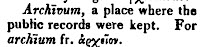
The word archives came from the Latin archivum, from the Greek archion (archive, record office; αρχείον)

From the same root
archival, archivist

In modern Greek
a) αρχείο: archives, file, record [archio]

OED

Η λέξη archives (αρχείο, -α) προήλθε από το λατινικό archivum, το οποίο αποτελεί μεταγραφή του ελληνικού αρχείον.

_________________________ Post 64. ___________


Κυριακή 7 Δεκεμβρίου 2008

ETYMOLOGY OF CLERIC - CLERGYMAN - CLERGY

Etymology of cleric.

Cleric derives from the latin clericus (priest), from the Greek clericos (priest; κληρικός).

From the same root.
clergyman, clergy, clerical, clericalism, clerk

In modern Greek
a) clericos: priest [κληρικός]
b) clericalismos: clericalism [κληρικαλισμός]
c) cleros: clergy [κλήρος]
d) cleros: lot, portion [κλήρος]

OED

Το cleric (κληρικός) προέρχεται από το λατινικό clericus (priest), από το ελληνικό κληρικός.


_______________________Post 61. ______________________

Σάββατο 22 Νοεμβρίου 2008

Etymology of BOMB

Etymology of bomb
Bomb derives from the french bombe, from the latin bombus (a buzzing sound), from the greek bombos (βόμβος).

From the same root.
bombard, bombardment, bombardon

In modern Greek
a) bombos (or better vomvos): buzz, drone [βόμβος]
b) bomba (or vomva): bomb [βόμβα]
c) bombardizo (or vomvardizo): bomb, shell [βομβαρδίζω]
d) bombardismos (or vomvardismos): bombing, shelling [βομβαρδισμός]
e) bombardistiko (or vomvardistiko): bomber [βομβαρδιστικό]
f) bombetes (or vomvetes): buzzer [βομβητής]

OED

Bomb προέρχεται από το γαλλικό bombe, από το Λατινικό bombus, από το ελληνικό βόμβος.

_______________________ Post 60. __________________


Παρασκευή 21 Νοεμβρίου 2008

BUFFALO derives from the Greek "boubalos"

Etymology of buffalo

Buffalo derives from the Portoguese bufalo, which in turn came from the Latin bufalus, a variant of bubalus (wild ox), from the Greek boubalos (buffalo; βούβαλος), from bous (ox, cow; βους).


In modern Greek
a) bubalos (or vuvalos or vuvali): buffalo [βούβαλος]
b) bubala (or vuvala): female buffalo [βουβάλα]

OED

Το buffalo προέρχεται από το Πορτογαλλικό bufalo, από το Λατινικό bufalus, παραλλαγή του bubalus, από το ελληνικό βούβαλος.


_________________________Post 59.____________________


Τετάρτη 19 Νοεμβρίου 2008

Etymology of alms

Etymology of alms
Alms derives from the old English ælmesse from the Vulgar Latin alemosyna from the Latin eleemosyna, from the Greek eleemosyne (ελεημοσύνη; alms, charity, mercy)

From the same root.
almoner, eleemosynary

In modern Greek
a) eleemon: charitable, beneficent [ελεήμων]
b) eleemosyne: charity, alms [ελεημοσύνη]
c) eleos: pity, mercy, compassion [έλεος]_

OED

Η λέξη alms (ελεημοσύνη) προέρχεται από παλαιό αγγλικό ælmesse από την κοινή Λατινική alemosyna από την Λατινική eleemosyna, από την ελληνική ελεημοσύνη.

_____________________________Post 58. ________________


Σάββατο 15 Νοεμβρίου 2008

ETYMOLOGY OF ALMOND

Etymology of almond.

Almond comes from the old french almande, from the Vulgar Latin amendla, from Latin amygdala, from the Greek αμύγδαλα-amygdala (almonds).

In modern Greek
a) Αμύγδαλα: almonds [amygdala]_

OED

Η λέξη almond προέρχεται από το γαλλικό almande, από το κοινό λατινικό amendla, από την Λατινική amygdala, από το ελλληνικό αμύγδαλα.


__________________________Post 57.___________________


Σάββατο 18 Οκτωβρίου 2008

ETYMOLOGY OF TONE

Tone derives from the Latin tonus, from the Greek τόνος (tonos; tone) from the verb τείνω (teino; to stretch)

In modern Greek
a) τόνος: tone [tonos]
b) τείνω: stretch [teino]

OED

Η λέξη tone (τόνος) προέρχεται από το Λατινικό tonus, από το ελληνικό τόνος από το ρήμα τείνω.

_______________________Post 55. ______________


Τρίτη 14 Οκτωβρίου 2008

Etymology of normal

Etymology of normal
Normal comes from the Latin normalis (in conformity with rule) from norma (rule, pattern, lit. "carpenter's square"), which derives (via Etruscan) from the Greek γνώμων (gnomon; rule, "carpenter's square.").

From the same root: norm, normality.

In modern Greeka) γνώμων: rule, motto, goniometer, protractor [gnomon].

OED

Το normal (φυσιολογικό, σύμφωνος με το νόμο) προέρχεται από το Λατινικό normalis από το norma (κανόνας, γνώμων), το οποίο προέρχεται (μεσω της γλώσσας των Ετρούσκων) από το Ελληνικό γνώμων.

____________________ Post 53. __________________________