Σάββατο 15 Νοεμβρίου 2008

ETYMOLOGY OF ALMOND

Etymology of almond.

Almond comes from the old french almande, from the Vulgar Latin amendla, from Latin amygdala, from the Greek αμύγδαλα-amygdala (almonds).

In modern Greek
a) Αμύγδαλα: almonds [amygdala]_

OED

Η λέξη almond προέρχεται από το γαλλικό almande, από το κοινό λατινικό amendla, από την Λατινική amygdala, από το ελλληνικό αμύγδαλα.


__________________________Post 57.___________________


Σάββατο 1 Νοεμβρίου 2008

The Primitive Greek Romans

I. The Primitive Greek Romans

1. The very existence of the primitive Greek Romans has been completely abolished by historians who continue to support Charlemagne's Lie of 794 which inaugurated the historical dogma that the Roman language was and is Latin. This has remained so in spite of the Roman sources which describe Greek as the first language of the Romans. It seems that Charlemagne's Lie of 794 was based on hearsay and the need to cut off West Romans enslaved to the Franco-Latins from the free East Romans. …
2. … The primitive Greek Romans were the result of the union of the Greek speaking tribes of Italy. These Greek tribes are the following: The Aborigines [2] who came to the area of Rome from Achaia, Greece many generations before the Trojan War. [3] These Aborigines had already accepted into their tribe what was left of the Greek Pelasgians of Italy who had been decimated by a mysterious sickness. [4] Porcius Cato's inclusion of the history of the Pelasgians in Italy and their union with the Aborigines in his De Origines, repeated in detail by Dionysius, is the only mention of them that this writer is aware of. These combined Aborigines and Pelasgians united with some Trojans who migrated to their land and together they became the ancient Greek speaking Latins whose capital was Alba Longa. A branch of these Greek speaking Latins of Alba Longa, led by the brothers Romulus and Romus, founded Rome on the Palatine and Capitoline Hills. They were joined by some of the Greek Sabines of Italy who had settled on the adjacent Quirinal Hill. The Sabines had migrated to Italy from Lacedaemonia in Southern Greece. [5] The Romans continued the process of subduing and including the rest of the Greek Latins and Sabines into their political system.

From the “Introduction to Romanity, Romania, Roumeli” by the late Prof. John S. Romanides (USA). The whole text and the footnotes (in square brackets) are available in this link: [ http://www.romanity.org/htm/rom.16.en.romanity_romania_roumeli.01.htm#s1 ].

Μετάφραση του ανωτέρου αποσπάσματος καθώς και πολλά άλλα στοιχεία υπάρχουν στο βιβλίο του εκλειπόντος π. Ιωάννου Ρωμανίδου "Ρωμηωσύνη", 2002.

Σάββατο 18 Οκτωβρίου 2008

ETYMOLOGY OF TONE

Tone derives from the Latin tonus, from the Greek τόνος (tonos; tone) from the verb τείνω (teino; to stretch)

In modern Greek
a) τόνος: tone [tonos]
b) τείνω: stretch [teino]

OED

Η λέξη tone (τόνος) προέρχεται από το Λατινικό tonus, από το ελληνικό τόνος από το ρήμα τείνω.

_______________________Post 55. ______________


Τρίτη 14 Οκτωβρίου 2008

Etymology of normal

Etymology of normal
Normal comes from the Latin normalis (in conformity with rule) from norma (rule, pattern, lit. "carpenter's square"), which derives (via Etruscan) from the Greek γνώμων (gnomon; rule, "carpenter's square.").

From the same root: norm, normality.

In modern Greeka) γνώμων: rule, motto, goniometer, protractor [gnomon].

OED

Το normal (φυσιολογικό, σύμφωνος με το νόμο) προέρχεται από το Λατινικό normalis από το norma (κανόνας, γνώμων), το οποίο προέρχεται (μεσω της γλώσσας των Ετρούσκων) από το Ελληνικό γνώμων.

____________________ Post 53. __________________________


Σάββατο 11 Οκτωβρίου 2008

ETYMOLOGY OF LEAF - FOLIO

Etymology of folio and leaf

Leaf comes from the Latin folium (leaf), which is related to the Greek φύλλον (fyllon; leaf).

From the same root.
foliation, foliate, foliar, portfolio, leaflet etc.

In modern Greek
a) φύλλο: leaf [fylo]
b) φυλλάδιο: leaflet, booklet [fyladio]

OED

Η λέξη leaf (φύλλο) προέρχεται από το Λατινικό folium (φύλλο), το οποίο σχετίζεταιμε το το Ελληνικό φύλλον.


______________________ Post 52 ____________________


Τετάρτη 8 Οκτωβρίου 2008

Etymology of taxonomy

Etymology of taxonomy

It derives from the French taxonomie coined from the Greek words taxis (τάξις; order, arrangement) + -nomia (method) from -nomos (νόμος; managing, law) from nemein (manage, distribute, put in order).

In modern Greek
a) τάξις: order [taxis]
b) νόμος: law [nomos]

OED

Το taxonomy (ταξινόμηση) προέρχεται από τις λέξεις τάξις και νόμος


____________________ Post 51 ____________________


Δευτέρα 1 Σεπτεμβρίου 2008

Etymology of Medicine

Etymology of medicine

The word MEDICINE comes from the Latin medico from medeor (I heal, cure) related to the Greek verb μέδομαι (medome; take care of, think, execute with great art).


From the same root: mode, model, moderate, meditate.


OED


Η λέξη MEDICINE (ιατρική) προέρχεται από το Λατινικό medico από το medeor (θεραπεύω), το οποίο σχετίζεται με το αρχαίο ελληνικό ρήμα μέδομαι (φροντίζω, θεραπεύω, σκέφτομαι, πράττω επιδεξίως) [μεδέων=προστάτης / μήδος=σχέδιο].


________________________Post 50._________________


Etymology of flame

Etymology of flame.

Flame comes from the Latin flamma (flame), which is related to the Greek verb φλέγω (flego; to burn, blaze).

From the same room: flambeau

In modern Greek.
α) φλόγα: flame [floga]
β) φλέγω: burn [flego]

OED

Η λέξη flame προέρχεται από το Λατινικό flamma, το οποίο σχετίζεται με το ρήμα φλέγω.


___________________Post 49. __________________

Etymology of scope

Etymology of scope.
Scope (aim, purpose, an end, extent or range of view) derives from the Latin scopus, from the Greek σκοπός (scopos; scope) from the verb σκοπέω (scopeo; aim, intend, watch).

In modern Greek.
a) σκοπός: aim, goal, end, sentry [scopos]
β) σκοπεύω: aim, intend [scopevo]
γ) σκοπιά: look-out post [scopia]
δ) σκόπιμα: adj intentional [scopima]

OED

Η λέξη scope (σκοπός, εύρος) προέρχεται από το Λατινικό scopus, από το ελληνικό σκοπός από το ρήμα σκοπέω (-ώ).

______________________ Post 48.______________


Etymology of door

Etymology of door.

The word DOOR is related to the Greek word θύρα (thyra; door).
The same word θύρα (thyra; door) and its Aeolic form φύρα (fyra) is related to the Latin foris (door) and fora (out of doors) and through it the English forth.

In modern Greek
a) θύρα: door, gate [thyra]
β) θυρεός: escutcheon [thyreos]
γ) θυροειδής: thyroid [thyroidis]

OED

Η λέξη DOOR (θύρα, πόρτα) σχετίζεται με  την ελληνική λέξη θύρα

___________________________Post 47. ____________________


Etymology of crown, corona

Etymology of crown, etymology of corona

The word CROWN derives from the Latin corona (crown), which is related to the Greek κορώνη (corone; curve, crown, garland)

From the same root: corona, cornice, coronet

In modern Greek:
a) κορώνα: crown [corona]
b) κορωνίς: apex, top, cornice [coronis]

OED

Η λέξη CROWN (στέμμα) προέρχεται από το Λατινικό corona (στεμμα), το οποίο σχετίζεται με τοελληνικό κορώνη. Από την ίδια ρίζα προέρχεται και η λέξη κορνίζα (cornice).


_____________________________Post 46. ______________


Κυριακή 10 Αυγούστου 2008

ETYMOLOGY OF DENSE, DENSITY

Etymology of dense

The adj dense derives from the Latin densus (dense), which is related to the Greek adj δασύς (dasys; dense).

From the same root: density

In modern Greek.
α) δασύς: dense, thick [dasys]
β) δασύτητα: density, denseness [dasytita]

OED

Το επίθετο dense (πυκνός) προέρχεται από το Λατινικό densus (dense), το οποίο σχετίζεταιμε το Ελληνικό δασύς.

_______________________Post 45.________________


Σάββατο 26 Ιουλίου 2008

ETYMOLOGY OF NEW, NOVICE

Etymology of new and novice

The words new and novice derive from the latin novus (new), is related to the greek adj νέος (new; neos). The word neo- (new; neo) is also used as a prefix in many words such as neolithic, neologism, neophyte, neoplasm, neoplatonism etc.

From the same root: news, novelty, novel, novelist, nova, neon

In modern Greek.
α) νέος: new, young, modern [neos]
β) νεότητα: youth, early years [neotita]
γ) νεόφυτος: newly baptized, novice, neophyte [neophytos]
δ) νέα: news [nea]

OED

Οι λέξεις new (νέος) και novice (αρχάριος, νέος) προέρχονται από το Λατινικό novus (νέος), το οποίο σχετίζεται με το ελληνικό νέος.


_____________________ Post 39. ___________________


Etymology of rice

Etymology of rice

Rice derives from the Italian riso, from the Latin oriza, from the Greek oryza (rice).


In modern Greek.
α) ρύζι: rice [rizi]

OED


Η λέξη rice (ρύζι) προέρχεται από το λατινικό oriza, από το ελληνικό όρυζα._

_____________________________Post 36._______________________

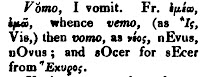
Etymology of vomit

Etymology of vomit

The word vomit came from the Latin vomitare from vomo (I vomit), which is related to the greek verb εμέω - εμώ (emo; I vomit).

In modern Greek
α) εξεμώ or κάνω εμετό: to vomit [exemo or kano emeto]
β) εμετός: vomit [emetos]

OED

Η λέξη vomit (εμετός, κάνω εμετό) προέρχεται από το λατινικό vomo (κάνω εμετώ), το οποίο σχετίζεται με το ρήμα εμέω - εμώ.

___________________________Post 35. ____________________